Boundary-Modeling AD
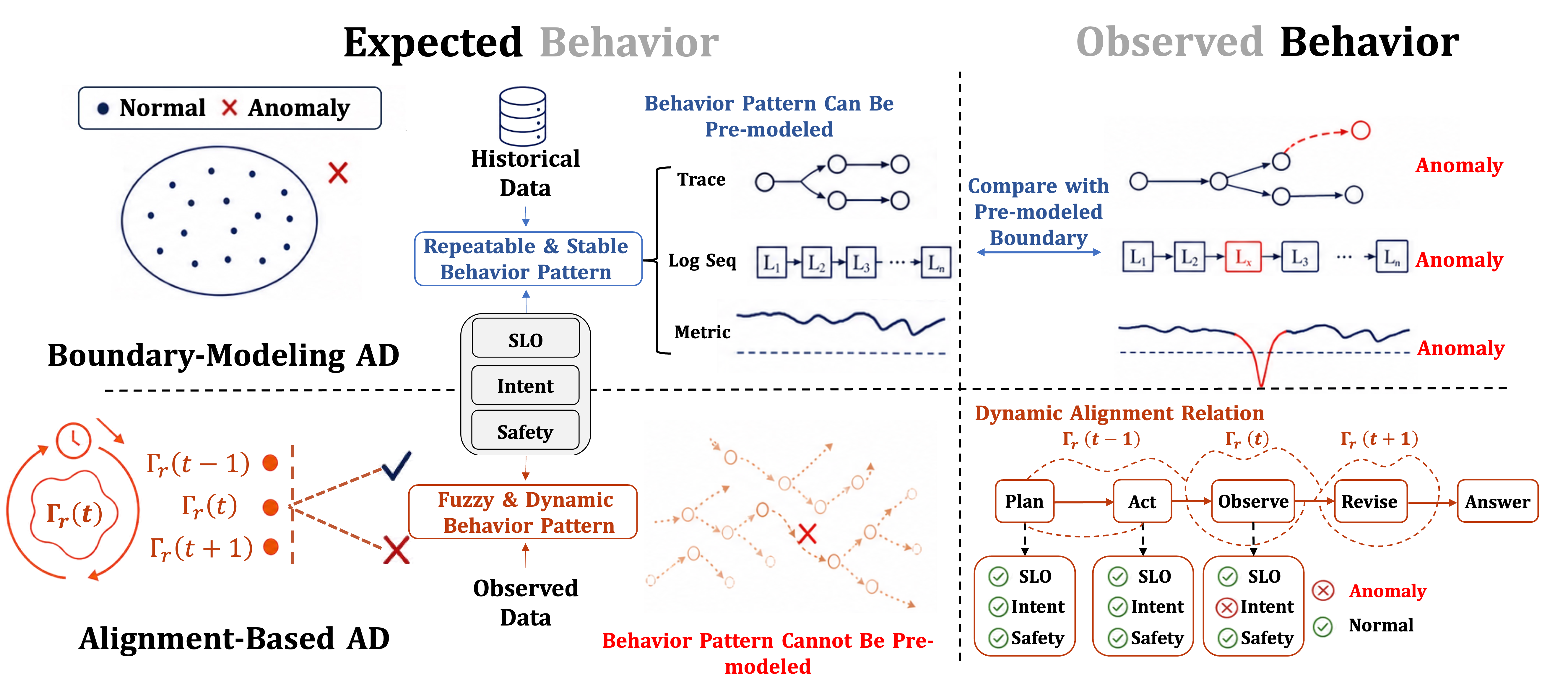
Constructs a boundary from the statistical, structural, or feature regularities of historical runtime data. Detection checks whether current behavior patterns lie within the accepted region.
Peking University / Research survey / 2026
How do detectors establish what behavior to expect
when LLM outputs and execution paths can change?
Two ways to establish anomaly decision conditions
01 / The perspective
Anomaly detection identifies behavior patterns that do not conform to expected behavior. This survey organizes methods by how they establish and apply the decision conditions.
Constructs a boundary from the statistical, structural, or feature regularities of historical runtime data. Detection checks whether current behavior patterns lie within the accepted region.
Constructs an alignment model connecting current behavior patterns with applicable requirements under the execution context. Detection evaluates its decision conditions; requirement violations indicate anomalies.
Different behavior patterns may fulfill the same request. Similar output formats or execution structures may still conceal anomalies. Historical resemblance alone may therefore be insufficient for a reliable anomaly decision.

02 / The taxonomy
Five principal families organize the selected methods by their detection mechanisms.
Each example is assigned to one principal family. Counts describe the survey's selected examples, not the overall publication population.
03 / The method directory
181 examples from the manuscript's active taxonomy.
| Method / publication | Principal family | Year | Publication link |
|---|
Try a different title, year, or family.
Bibliographic years follow the manuscript roster; they are not uniformly first-publication dates. Hybrid methods are listed under their principal mechanism.
04 / Alignment in practice
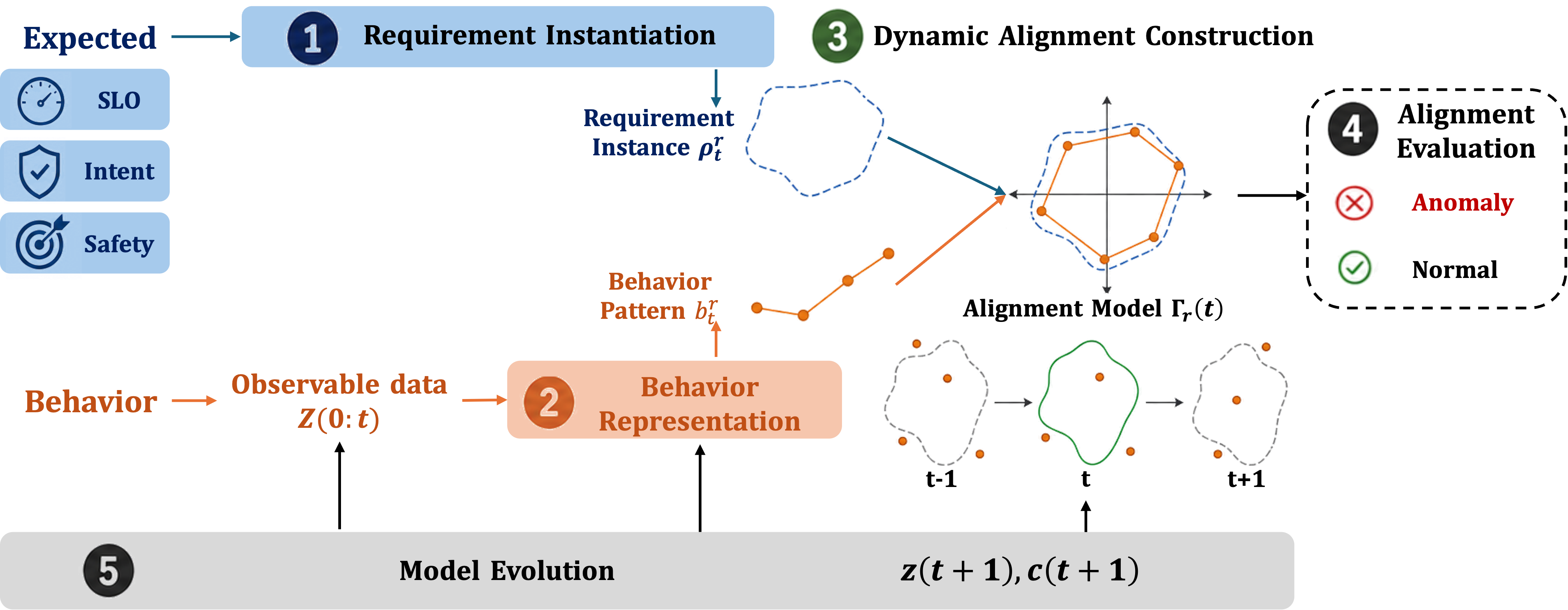
Five activities describe how alignment models are constructed, evaluated, and updated. They can be combined and revisited as execution changes.

05 / Coverage & open questions
The scope includes LLM-based applications, RAG systems, agents, and their runtime components for serving, orchestration, observability, verification, and governance.
The search covered ACM Digital Library, IEEE Xplore, Scopus, Web of Science, and arXiv, for records from January 2022 available at the July 10, 2026 retrieval cutoff.
Representative examples were selected for methodological distinctiveness and taxonomy coverage. Earlier foundational work was identified through backward reference tracing.
Ambiguous or implicit goals can lead to different anomaly decisions for the same behavior. Requirement instantiation must preserve intended goals and constraints while making unresolved ambiguity explicit.
SLO, user intent, and safety requirements can interact or conflict. Evaluation must retain separate condition-level results and evidence; achieving one goal does not cancel a mandatory constraint violation.
Mapping requirements and behavior into related representations may weaken features that reveal a violation. Representational similarity should not be mistaken for conformity to expected behavior.
Evidence retrieval, inference, verification, and model updates incur runtime costs. Incremental updates and selective verification must be evaluated alongside detection effectiveness and delay.
Blocking, retrying, or replanning too early may interrupt useful reasoning and self-correction. Intervention should account for subsequent execution and final task outcomes.
06 / Citation
Preprint v1 · October 10, 2026
Chiming Duan et al., Peking University
@misc{duan2026anomaly,
title = {Anomaly Detection in LLM-Based Systems: A Survey},
author = {Duan, Chiming and Jia, Tong and He, Minghua and Zhang, Lingzhe and Wang, Haobo and Li, Ying},
year = {2026},
publisher = {alphaXiv},
url = {https://www.alphaxiv.org/abs/2610.anomaly-detection-llm-systems},
keywords = {Software Engineering (cs.SE), Artificial Intelligence (cs.AI), Security and Privacy (cs.CR), LLM-Based Systems, Anomaly Detection, Reliability, AIOps, Alignment-Based Detection}
}This preprint has not been peer reviewed.